September 17, 2013

Chocolate Hazelnut Cheesecake Brownies


This is a decadent little brownie which I am sure is not part of anyone's weight loss regime.  But hey you've got to splurge every once in a while right? This recipe has two parts, the cake-like bottom and a creamy top...all in chocolate hazelnut! I used 16 ounces of cream cheese along with 8 eggs and an entire jar of hazelnut spread. I then decided to add some toffee bites to the top to provide a crunchy contrast to the brownie's creaminess, and the little bit of toffee saltiness highlights the chocolate flavor.

Ingredients:

2 cups of flour
1/2 cup of powdered cocoa like Hershey's
8 eggs
2 1/2 cups of sugar
1 13 or 14 oz jar of chocolate-hazelnut spread
1 1/3 cups of butter, melted and cooled
2 8 oz. pkg. of Neufchatel cream cheese, softened
Heath English Toffee Bites

 First preheat your oven to 325 degrees and spray coat a 13 x 9 x 2 inch baking pan with cooking spray, then set it aside. Next in a medium mixing bowl, mix together the flour and cocoa.

In a large mixing bowl beat with an electric mixer on low to medium speed...4 of the eggs with the sugar, 1/2 cup of the hazelnut spread and the melted butter until combined  Now fold in the flour mixture and beat until smooth. Pour this mixture into your prepared pan and spread it out evenly.


Wash the mixer's beaters and in another large bowl beat the cream cheese with the remaining 1/3 cup of sugar on medium speed until light and fluffy. Beat in 4 eggs and remaining hazelnut spread until all ingredients are combined. Then carefully pour over the batter in the pan and spread out evenly. Place in the oven and bake for 50-55 minutes until the cheese layer is set and firm. Cover and chill before serving. Sprinkle with Heath English Toffee Bites.

Just perfect with a nice cold glass of milk!


(This recipe was adapted from Better Homes & Gardens Fall Baking 2013 issue)


Sharing this post at these super blog link parties...


September 15, 2013

Cajun Vs. Creole Plus an Authentic Jambalaya Recipe


While my sister Kim and I were in New Orleans last week, I  somehow manage to stumble across the New Orleans School of cooking while out for a walk on Monday morning. I immediately signed up for the $29 cooking demonstration scheduled for Tuesday which was to run from 10:00 to 12:30. Included in the price was lunch plus beverages, and a taste of Louisiana's own Abita beer.


Chef Michael was our demonstrator of the morning and he not only prepared the most incredible Gumbo and Jambalaya, but he also gave us a complete and colorful history lesson about the how the flavors of this region's food came to be. 

As you probably already know, Cajun and Creole are the two main types of fare you'll find in New Orleans and are represented by people known as Cajuns and Creoles respectively.  Both groups are heavily influenced by French culture, but the differences in how each group developed keeps them distinguishable. Arguably the main difference between the Cajuns and Creoles lies in the way each group migrated to Louisiana.

Chef Michael explained how the Cajuns, who were originally French columnist in Canada called Acadiens, came to Louisiana as a result of the British government becoming fearful that the Acadiens would rise up and fight with the French during the French Indian war of the early 1700's. By mid century the British seized the Acadiens' farms and burned their villages because they would not adopt the king's Protestant religion and defend the royal kingdom. So after 40 years of refusing to abdicate their beliefs, British soldiers loaded Acadian families on ships of various destinations from New York to the West Indies. Some ended up in Louisiana where they were found acceptance with it's French background and Catholic heritage. This is where the Acadiens became known as Cajuns as they developed their own distinct lifestyle in the swamps and surrounding areas of Louisiana.

Creoles on the other hand are little bit harder to define but typically they are the descendants of the settlers in the New Orleans area. These settlers are of  French, Spanish, Italian, Caribbean and African ancestry, and descendants of African Americans both slaves and free.  

The difference in cooking has to do with where each group settled in Louisiana. Cajun cooking is though of as "country" fare since the Cajuns had to live off of the land and often used pots for cooking. Their food incorporates meats like pork, chicken, sausage and craw-fish  Cajun cooking will tend to lean on the "holy trinity" of vegetables which are celery, bell pepper and onion, and is typically spicy since cayenne pepper is used good amounts along with herbs like thyme, paprika, parsley and pepper.

Creole cooking is sometimes referred to as more "urban" fare since the Creoles had access to a larger variety of foods native to their countries of origin, as well as to local markets. European influences is largely infused into creole cuisine. Creole dishes utilizes lighter proteins like shrimp, crab and oysters. The "holy trinity" is also used in creole cooking with the addition of tomatoes and garlic (or the "pope" as Chef Michael likes to refer to garlic) which is a sign of Italian influences. The Creoles use less cayenne in their cooking and rely more on allspice, mustard and okra which results in very flavorful but not too spicy dishes. 

Both styles of cooking incorporate the use of a flour as a base to thicken dishes. The Creoles use butter with flour while the Cajuns use oil.


On the menu for lunch was...
Gumbo
Jambalaya
Banana's Foster 
and Louisiana pralines 

...all made right in front of our class of 40!


New Orleans School of Cooking Jambalaya Recipe

serves 12

Ingredients:

1/4 c. oil
1 cut up chicken de-boned and cooked
1 1/2 lbs of Andouille sausage, sliced about 1/3 inch thick

The Trinity
4 c. chopped onions
2 c. chopped celery
2 c. chopped green pepper

The Pope
1 T chopped garlic ( I do throw in more)

4 c. long grain rice
5 c. chicken stock

Cajun seasoning...black pepper, onion powder, garlic powder, salt and paprika, dried thyme or you can purchase Joe's Stuff Seasoning
2 cups of chopped green onion or tomato

Season and brown the chicken in oil or if you have it on hand, bacon fat, over medium heat. Add sausage to pot with chicken and continue to saute. Remove the meat from the pot leaving the drippings. 

Next saute the trinity along with the Pope in the drippings until tender. Return the meat to the pot and add your seasonings plus gradually pour in the stock and bring to a boil. Stir in your rice, cover and let simmer for about 25 minutes. Uncover and quickly turn the rice from top to bottom completely. Replace cover and let sit for another 20 minutes, then stir the rice in the same fashion again from top to bottom. Add chopped green onions an tomatoes if desired.


The New Orleans School of Cooking is located at
542 Louis Street right in the heart of the French Quarter.
Phone number (504)525-2665
or outside of Louisiana (800) 237-4841

If you plan on visiting New Orleans and would like to attend one of the school's classes, make sure you call ahead for a reservation. Classes do fill up fast.

Sharing this post at these wonderful blog link parties...
Alderberry Hill
StoneGable

September 13, 2013

Eating our way through New Orleans' French Quarter


Last weekend my sister Kim and I flew down to the Big Easy for 5 glorious days. While Kim did have work obligations, I on the other hand (hehehehe) did not, we still found plenty of time to experience New Orleans fabulous Cajun/Creole cuisine.


Kim actually had the opportunity through her work to dine on classic Creole cuisine at Aurauds, one of the French Quarter's premier restaurants. 


This main dining area is just stunning isn't it?? So old-world South. It felt like Scarlet O'Hara could just come whizzing through the room at any moment!


Arnaud's was started by a colorful French wine salesman back in 1918 by the name of Arnaud Cazenave. The food here according to my counterpart Miss Kim, was simply fabulous!!!


And as it happily turned out, one of our favorite spots to eat was right on Royal Street, just a couple blocks from where we were staying at Hotel Monteleone. Aptly named the Royal House,  it offers open-air dining and classic traditional seafood fare. 


Here we are enjoying an early lunch of oysters...they went perfect with my Cajun Bloody Mary!


Let me tell you that the Royal House's fresh shucked oysters were unbelievably plump and delicious! The price for the dozen was very reasonable...12 oysters for a mere $13. Can't beat that on a half-shell!


I had even stopped in one day for a quick seafood gumbo lunch...service was fast and the gumbo was manifico!!


Another cute open air restaurant in the Quarter is Cafe Pontalba located in Jackson-Square. It is fun spot to people-watch while feasting on creole dishes like blacked red fish or shrimp etouffee.


Kim may have dined at Arnaud's but I had the chance to take a cooking class while she was at work.


I had stumbled upon the New Orleans's School of Cooking located on St. Louis Street about a block from the Cathedral of St Louis King of France.  For only $29 you get a 2 1/2 hour cooking demonstration on how to make 4 authentic New Orleans dishes. Below is chef Michael...he made an ah-mazing gumbo and jambalaya which we got to eat as part of the lunch included in the demonstration's price! We also got pitchers of Louisiana's Abita beer as a libation. I will tell you more about those recipes in upcoming posts, but let me say for the record in the words of Chef Michael..."it is the best you've ever eaten!"


In the same building as the cooking school is a darling general store for all of your Cajun culinary needs.


Another place which is a "must go to" while in New Orleans is Cafe du Monde for their famous coffee and biegnets, or French donuts.

To read more about Cafe du Monde click here.


There were a number of wonderful places to eat which made it really hard to chose where to go, even after studying menu after menu for the better part of a day. Also the outside dining areas were incredibly quaint and charming which made it nearly impossible not to feel immersed in the unique culture of the Quarter.


So truth be told, we did not eat our way completely through the city, but given enough time I think we just may have had a shot at completing our quest. Louisiana cooking and New Orleans cuisine is very much tied to its diverse culture. It blends together the flavors and ingredients of the French, Spanish, Portuguese and Native Americans, along with African influences, like no place else in the world.

Someday we'd love to go back to New Orleans and its French Quarter, but until that time I suppose we will have to be happy creating dishes inspired by this colorful southern region in our own kitchens.


Sharing this post at the wonderful blog link parties...

September 9, 2013

Dining in the French Quarter ~ Cafe du Monde

One the main places I was told to make sure I visited for just coffee and one of their famous Biegnets, was Cafe du Monde located in the French Quarter. So today I took a troll down to try one of these wonderful French donuts. It was serve hot and was roughly about a dollar and some change for three of them. believe me 2 was enough for this gal!


The cafe itself is easily identified by their quaint green and white striped awning. You can dine under the awning or inside the cafe.


Inside you just find yourself a seat and one of the waitstaff will promptly come on over to take your order.
The Beignet is serve hot with plenty of powdered sugar on top!


OK so here's the skinny on these French donuts...there ain't nothing skinny about 'em!!! But they are in fact, absolutely delicious!!! You will want to walk to Cafe du Mode just you can burn off the extra calories on the way back to your hotel!


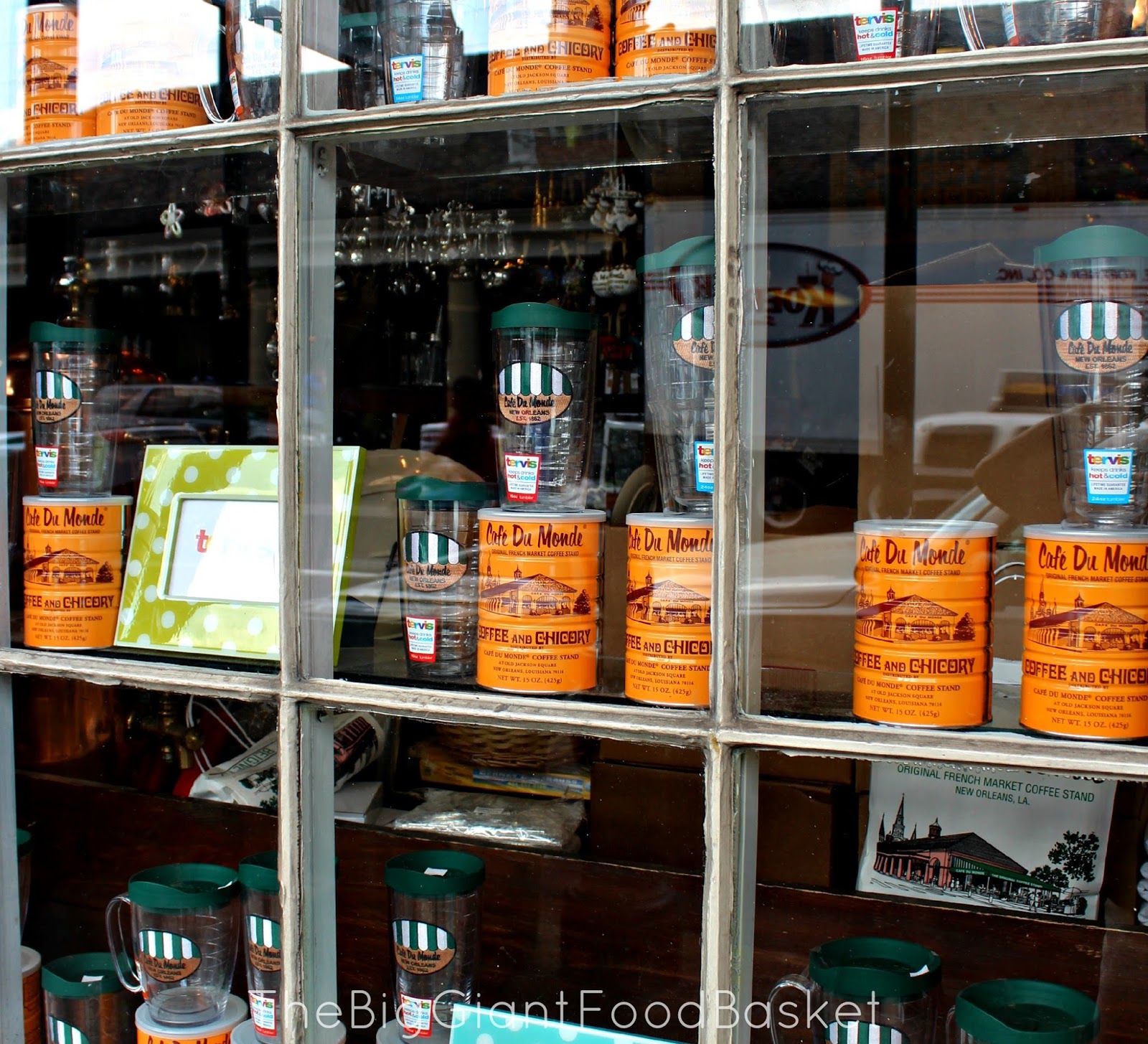
You can even bring a little of the cafe home with you!


Visiting Cafe du Mode id definitely part of the  New Orleans experience you definitely don't want to miss.


The cafe is located on 
800 Decatur Street
New Orleans 70116

and at
500 Port of new Orleans
Ste. 27
New Orleans 70130

September 6, 2013

Elegant and Easy 4 Layer Carrot Cake


It's back to school time and for me this time of the year has always been very nostalgic for me. Believe it when I say that I've been out of school for many moons now, but the return of the cooler Canadian air along with the warm September sun just makes me long for some of my favorite childhood comfort foods. Carrot cake is a pure comfort food, wouldn't you agree? So today I decided to try making this cake with a little bit of a twist. Instead of baking it in conventional cake pans I actually baked it in an 16 X 11 jelly roll pan, cut the cake into 4's and then stacked them to create an elegant look.

The ingredients are pretty basic but since the cake is in a wider longer pan, the baking time is drastically reduced. The authors of this recipe adds baking soda to the batter in order to raise the pH enough to soften the carrots during the short cooking time. And it did work, the carrots were cooked perfectly.

Ingredients:

1 3/4 cups all-purpose flour
2 tsp. baking powder
1 tsp. baking soda
1 1/2 tsp. ground cinnamon
3/4 tsp. ground nutmeg
1/2 tsp. salt
1/4 tsp. ground cloves
1 1/4 cups packed light brown sugar
3/4 cup vegetable oil
3 large eggs
1 tsp. vanilla extract
2 2/3 cups shredded carrots

I used store bought cream cheese frosting, roughly 32 ounces, but of course you can always make your own.
2 cups chopped pecans


First set your oven's baking rack to the middle position, then preheat it to 350 F. Prepare your jelly roll pan by greasing it with cooking spray and then lay a a piece of parchment paper on top and grease the paper with the spray.

In large bowl whisk together the first seven dry ingredients. In another large bowl whisk together the brown sugar, vegetable oil, eggs and vanilla extract. Stir in the carrots and the dry ingredients. Then using a rubber spatula, fold the mixture until it is just combined. Pour the batter into your prepared pan making sure to spread the batter into the corners. Place in oven and bake for 16-18 minutes. Remove from oven and let cool 5 minutes on a baking rack. 

Next transfer the cake onto the rack with the parchment paper still under the cake and let cool completely, about 30 minutes. Once cake is cooled, slice the cake in half crosswise cutting through the parchment paper as well. Then slice each half lengthwise, again making sure you cut the parchment paper, to create 4 equal rectangle cakes. 


Using a cake board or large plate turn one of the cakes onto it, paper side up, and then carefully peel off the paper. Spread about 1/2 to 2/3 cup of frosting on to the first layer and then repeat for the other three layers. (If your cake has baked with an uneven thickness, adjust the orientation of the layers so they are stacked to produce a level cake.) Once your cake is assembled frost all 4 sides of the cake. Then gently press the chopped pecans into the 4 sides of the cake. 


Chill for about one hour before serving.

Enjoy!!!

(This recipe was adapted from The Best of America's Test Kitchen 2013)


Sharing this post at link parties over at these wonderful blogs...
StoneGable
Posed Perfection
Daily Dish Magazine
BeColorful
Ivy & Elephants
It'sOverflowing
Common Ground


September 3, 2013

Farmhouse Vegetable and Barley Soup (with homemade croutons)


Weeknights tend to get hectic this time of the year with all of the after school activities and such, so I am always on the hunt for no-fuss easy diner time ideas. This is hearty yet nutritious soup can be made ahead and be served up as great for a quick weeknight dinner. To give this soup's broth some depth of flavor, I tossed in whole Baby Bella mushrooms instead of the expensive dried Porcini mushrooms the recipe called for. I also omitted the turnips because I didn't have any on hand, and just used Yukon Gold potatoes.


Ingredients:

8 oz. pkg of Baby Bella Mushrooms, rinsed thoroughly
4 sprigs of fresh thyme
8 sprigs of fresh Italian parsley, minced
2 bay leafs
2 T unsalted butter
3 large leeks, white and light green parts only, slice in half lengthwise and then sliced into 1/2 inch thick pieces and rinsed thoroughly 
2 carrots peeled and diced
2 celery stalks cut into 1/2 inch slices
23 cup dry white wine (sauvignon blanc)
2 T soy sauce
4 cups low sodium chicken broth
1/2 -3/4 cup pearl barley
2 garlic cloves, crushed
2 Yukon Gold potatoes
1/4 of a cabbage, chopped
1/2 cup frozen peas
1 tsp lemon juice
salt and pepper

Heat the butter in a dutch oven or large pot and add the leeks, carrots, celery, wine and soy sauce. Let simmer stirring occasionally, until the liquid has evaporated and the celery is soft. Roughly 10 minutes.

In the meantime, tie together the thyme and parsley with some kitchen twine. Once broth is evaporated, add the broth, barley, mushrooms, herb bundle, bay leaf and garlic, plus 2 cups of water to the pot. Bring to a boil and then reduce heat to medium-low and let simmer for about 25 minutes.

Add the potatoes and cabbage and return to a simmer for another 18-20 minutes.

Remove pot from heat and remove the herb bundle and bay leaf. You can also take out the mushrooms at this time and set them aside for another use. (I just ate them whole - they were so yummy after cooking in the broth.) Stir in the peas and lemon juice and season with salt and fresh cracked pepper if you have it.

_________________________________________

To make the croutons...

Melt 2 T of unsalted butter in a small pan. Add some fresh thyme and parsley and stir for 20 seconds. Take 4 slices of hearty white bread and cut it into 1/2 inch pieces. Trim off the crust. Once butter is hot add the bread and season with salt and pepper. Cook the bread until it is a gold brown, 5-10 minutes. Remove the bread and let cool on paper towels.

Serve soup with the croutons and some more minced fresh parsley sprinkled on top.

Enjoy!
(This recipe was adapted from The Best of America's Test Kitchen 2013)

Sharing this recipe at these wonderful blog parties...
Posed Perfection
Daily Dish Magazine
StoneGable

Trip Advisor